03 / FUNDAMENTALS · PILOT FIELD GUIDE

Read the numbers.
Know your ship.

The complete measurement glossary, followed by how hardware, fitting and cargo combine into the totals you fly.

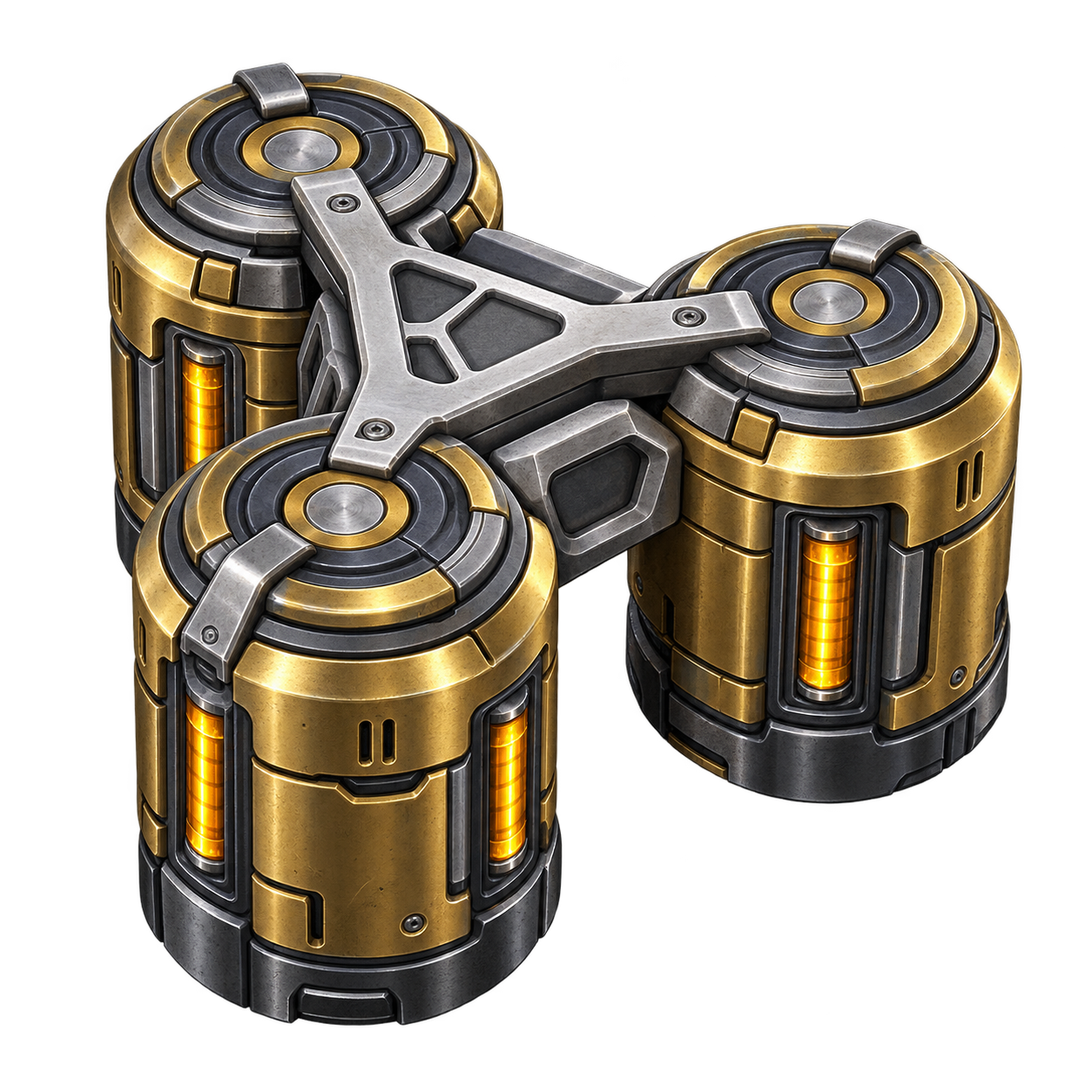
Trinity reactor system

Every unit has a job.

Rz

Distance & movement

Rz · Rezon
Layer distance: hull dimensions, weapon range and sensor radius. Camera zoom changes presentation, not Layer size.
Rz/s · speed
Rezon travelled each second.
Rz/s² · acceleration
Change in speed each second; also useful for braking.

12,000 Rz range · 285 Rz/s cruise

t / °

Mass, force & turning

t · tonnes
Loaded mass includes frame, fitted hardware and cargo. kt means 1,000 t; Mt means 1,000,000 t.
kt·Rz/s² · thrust
Drive force. Thrust divided by loaded mass gives acceleration.
Mt·Rz²/s² · torque
Turning force. Torque divided by rotational inertia gives angular acceleration.
° / °/s / °/s²
Bearing in degrees, turning rate and angular acceleration. Bearings run clockwise from 000° at the map’s top.
rad/s · radians per second
Missile guidance turning rate. One radian is about 57.3°.

200 t frame · 30 °/s turning

HP / SP / DP

Survive & deal damage

HP · Hull Points / Hit Points
Structural durability. Hull totals combine the frame and fitted contributors.
SP · Shield Points
Shield capacity, separate from Hull HP.
DP · Damage Points
Generic weapon damage before target defenses; DP/s is potential damage per second, not guaranteed applied damage.
HP/s / SP/s
Nanite Repair and shield recovery per second. Energy availability can limit actual recovery.

7,044 HP · 120 SP · 24 DP/s

MJ

Energy & efficiency

MJ · megajoules
Stored capacitor energy and energy costs.
MJ/s
Capacitor recharge and active consumption per second. The capacitor owns recharge; the reactor supplies the separate LOAD fitting budget.
MJ/HP / MJ/SP
Energy needed per repaired Hull Point or restored Shield Point. Lower costs improve efficiency.
LOAD · Reactor Load
The separate hardware-fitting budget. Installed items reserve it. It is not MJ, MJ/s or another energy rate.

180 MJ reserve · 6 MJ/s · 38 LOAD

CU

Capacity & quantities

CU · Capacity Units
Space shared by fitted primary Ship Systems and cargo. Weapon hardpoints and optional System Module bays have separate caps.
Compact storage badge
The small gray number in an item card’s top-right corner is its storage CU. Full capacity summaries still show CU.
Units / rounds / missiles
Resource and ammunition quantities. Resources and basic slugs stack to 1,000; Basic Missiles stack to 200. A partly filled stack still occupies its stack space.
Burst
Pilot currency, shown with the Burst symbol. Your wallet is separate from physical cargo.

100 CU total · 250 / 1,000 units

THz / s / %

Signal, timing & ratings

THz · terahertz
Gameplay Frequency, always four decimals. The exact number identifies a physical Layer. Its major band controls Astronav travel steps. Squadron membership is a separate four-digit pilot setting.
s · seconds
Acquisition, cooldown, cycle and countdown durations. A 2.00 s acquisition takes two seconds; a rate uses amount Unit/s.
% / ×
A proportion or multiplier, such as a 50% throttle setpoint or 1.20× modifier.
Quality / Extraction Power
Named ratings, not physical units. Quality summarizes relevant rolls. Mining Extraction Power is work per cycle against ore resistance; compare it with the ore and laser details.

1.1840 THz · 2.00 s · quality 80

Commas group thousands; units retain their case. A rate is written 13.2 HP/s, with one space before the unit and none around its slash. These labels describe the game’s existing values, not a change of scale.

Five primary systems, six items

Hull

Durability plus any Nanite Repair. Applied Lattice Hull Plating includes powered Nanite Repair; Bulwark Hull Plating favors durability. The hull frame also has its own intrinsic durability.

Energy

Reactor and capacitor are separate items. Reactor output limits installed hardware in LOAD. The capacitor stores MJ and owns its recharge rate: reserved LOAD multiplied by its family and rolled efficiency, then modified by tuning and the strongest Quantum Stabilizer. The reactor has no separate charging bottleneck or self LOAD.

“Reactor Load: 38 LOAD” reserves 38 LOAD of fitting capacity while installed. Operating energy is measured in MJ, with recharge and active CAPACITOR DRAW in MJ/s.

Propulsion

Cruise speed, thrust and turning torque are drive properties. Loaded mass sets acceleration and braking; loaded inertia sets turn acceleration and the fitted turn ceiling. Ordinary flight and steering have no recurring capacitor cost.

Shields

Capacity, recovery and energy efficiency. Shields recharge continuously when enabled, clear to arm, and supplied with energy. Moving the balance toward capacity trades away recharge speed.

Active shields use the bubble for collisions. Disabled or depleted shields use the hull. Re-arming waits until there is room for the bubble.

Sensors

The live detection radius around your ship. Factory Horizon sensors see 12,000 Rz out: a 24,000 Rz diameter. Other bases and rolls change that range. Explored geography stays charted; live ships and loot still require sensor coverage.

Reading an item

Base → size → rolls → fit

The base determines its strengths and tradeoffs. The size class sets its scale. Independent rolls determine relevant outputs, compactness, weight efficiency and fitting efficiency where applicable. Overall quality summarizes those meaningful rolls; it adds no hidden universal multiplier.

Carryable items retain their rolls when moved to another hull. Applied Hull Plating stays with its frame, whose occupied area determines its support CU. Compare its CU, mass and fitting draw with the resulting ship performance. Forge previews show the exact rolled stock you receive.

Power during flight

Weapons, repair, shield recovery and active abilities use operating energy. Basic propulsion and sensors continue working with an empty capacitor because their installation already reserves reactor output.

Combat, Defense and Repair presets change which consumers get priority. Shield and capacitor balance changes apply gradually and never create free charge.

Cruise first; overdrive when needed

Normal travel uses your propulsion item’s cruise speed. Optional Emergency Overdrive hardware gives a deliberate escape or travel burst: 25 MJ to activate, an 8-second window, and a 60-second cooldown from activation. Actual boosting also consumes energy.

Activate it through its fitted action-bar control. It must be fitted; there is no permanent built-in boost toggle.

Where to change things

I → Ship Systems inspects your hardware and exposes live balance controls. Replace system items at a faction Forge using carried equipment or fabrication resources. The replaced equipment returns to your Cargo; Hull Plating adds to the ship’s intrinsic frame and is applied through Forge Shop, not carried as cargo. Its fitted support space scales with the hull’s occupied area; higher-grade plating keeps its material mass and performance. Usable CU comes from occupied hull profile and depth after fixed hardpoint and system-bay reservations. Boxier or deeper designs can carry more without making every ship longer. Six required Ship Systems share that remaining space with cargo. An overfull cargo hold or insufficient reactor output blocks the refit.

Browse hulls, system families, exact Forge stock and modifiers →

Extraction Power

A mining laser supplies work every 20 seconds. Divide its power by ore resistance to get average units per cycle: Alloy 4, Iridium 7, Plutonium 24, Depleted Uranium 12. Fractional work carries while the target remains assigned. More valuable ores take more work; better lasers and multiple mining hardpoints improve throughput.

First upgrades through combat

Anchor pirate alerts offer short starter fights with Burst and a chance of usable hardware. Shared sensor locks, energy and ammunition rules apply to those ships too. The related civilian Wayfarer is weaker than a modern Viper, but its local responders are not.
These are the alpha’s current mechanics. The rules are explicit; their balance will evolve through playtesting.

Drive families and ship classes

Vector balances the job; Slipstream favors cruise; Impulse favors acceleration and braking; Pivot favors turning; Compact saves fitted CU, mass and reactor capacity. Six independent 1–100 property rolls determine the drive, with their average as quality. The Forge compares the actual fitted result and can swap compatible drives carried in Cargo.

Torque divided by fitted inertia gives angular acceleration. Maximum turn rate is one second of that acceleration, so heavier cargo also lowers the turning ceiling.

Frigate, Destroyer, Cruiser, Battleship and Dreadnought describe fixed frame sizes, separately from roles such as gunship or mining. Current player hulls include Frigate, Destroyer and the special Deadband Salvo Battleship; ordinary hardpoint guides are 2–4, 3–5, 4–6, 5–7 and 5–10 respectively.

Knowledge, cargo and headquarters

Frequency tunings and ship blueprints are physical tradeable data items: up to 100 identical copies per 1 CU stack. LEARN ONE COPY in Cargo consumes one and stores permanent pilot knowledge, confirms the item by name and preserves your browsing view. Duplicates stay in the stack. The Nexus’s top-level Pilot Knowledge panel shows learned designs and locked, learned and visited Layers. All pilots begin this phase headquartered at Anchor; existing ships, possessions and learned designs are retained.

The accessible headquarters share a lower-end encounter and equipment bracket, with strong faction protectors. Rift depth and elite fits still matter. Anchor miners extract the ores in their actual local asteroids, return to the depot when their custom NPC hold is full, and leave their carried resource cargo in wreck loot.

The starter Viper now accelerates and turns more readily. Larger drive sizes provide greater thrust and torque but heavier ships handle more slowly; Vector, Slipstream, Impulse, Pivot and Compact retain their distinct fitting choices. The provisional class target is up to 125% of the previous class’s overall capability for comparable roles, not a blanket stat multiplier. Deadband Salvo is the special Battleship entry.